 Demon VS Robot DVSR Marketing Website
In 2026, the phrase “content repurposer” has more than one connotation, and that difference is important. It can mean a method that changes current assets in a planned way, a person or group of people who are in charge of changing material, or a piece of software that does the whole job automatically.
The publishing world has changed. Algorithms change without warning, short-form material takes up most people's time, and people are on a dozen sites at the same time. It is not practical or cost-effective to make new material for every channel. If you have the right framework in place for repurposing, one webinar can create 10 to 20 different pieces of content.
This book tells you all you need to know about the content repurposer, including what it is, how to use it, examples for different formats, AI-powered tools, and the strategic choices that set high-performing teams apart from those that are still starting over every week. Here is what you will get:
- A clear, useful explanation of the content recycler in three dimensions
- How to turn one thing into many with step-by-step plans
- Examples of repurposing in different formats (blog, video, radio, ebook)
- A look at the differences between AI-powered tools and human processes
- The most frequently asked questions about reuse and SEO safety are answered here.
What Is a Content Repurposer?

A content repurposer is a process, tool, or role that takes content that already exists and changes it into new formats and channels to get the most people to see it, interact with it, and get the most return on investment (ROI) without having to start again.
Think about how a skilled craftsman works with raw materials. The same basic notion can be modified in many ways to fit different people and situations. That one blog post is more than just an essay. There is a carousel, an email newsletter, a short video script, and a Twitter/X thread that are all ready to be taken out.
The idea works in three different ways, and each one is important depending on how your team is set up and what you want to achieve.
Concept | Definition | Example | Key Benefit |
Content Repurposer | Process/tool/role that adapts content | Blog → video clips, carousels | More outputs from same idea |
Crossposting | Same content posted unchanged | Same caption & image on IG/FB | Fast, low-effort distribution |
Reposting | Sharing previous content again | Re-sharing top LinkedIn posts | Revive reach on proven content |
In the content marketing world, it's important to know what some terms mean. Content recycling means using content again with few changes. Content remixing means taking ideas from different sources and putting them together. Content atomization breaks a single pillar piece into topic-specific micro-assets. Content distribution controls how those assets get to the people who need them.
Why Use a Content Repurposer? 12+ Proven Benefits
There is no shortcut to repurposing. It is a strategic lever that links making content to business results that can be measured. those that build repurposing into their content supply chain always do better than those that approach each channel as a blank slate.
There are four groups of benefits:
Efficiency & Cost
- Cut the time it takes to make a campaign by 50–70%. It takes a lot less time to adapt an existing framework than to construct one from scratch.
- Lower the expenses of making things. Fewer shootings, fewer hours of writing, and fewer design briefs mean that the original asset has more intellectual weight.
- Keep a steady schedule for publication. One strong pillar item might give you weeks of material for a given channel.
- Make it easier to reuse knowledge. A well-repurposed item becomes a template that may be used by teams that are spread out.
Reach & Audience Growth
- Get in touch with new groups of people. Carousels are for people who learn by seeing, podcasts are for those who commute, and blogs are for people who read.
- Change to formats that work with the platform. Reels, Shorts, and threads all give prizes for content that fits their format.
- Get more people to interact with each idea. More format options mean more “shots on goal” over the life of the material.
- Make content last longer. A blog post that gets a lot of traffic can keep getting traffic on social media for months.
- Help with sales enablement. Webinars turn into one-pagers and things to leave behind after a sales call.
- Make the experience better for users. Meeting your audience in the way they like to communicate develops trust.
SEO & Authority
- Topical groups can help your SEO. Reusing assets builds subject authority across a domain.
- Build up your backlinks. People link to infographics and data visualizations more than they link to plain blog posts.
- Boost conversions. You can make CTAs work with each format and medium by reusing them.
Strategy & Resilience
- Prepare for changes to the formula. Publishing on more than one site protects your audience from changes on any one platform.
- Make information more valuable. When one idea leads to 12 assets, it's easier to figure out who is responsible for what and the profits can be measured.
Scenario | Original Asset | Repurposed Into | Result Metric |
B2B SaaS blog | 2,000-word article | 8 LinkedIn posts + 3 Reels | +180% LinkedIn reach |
Solo creator podcast | 45-min episode | 12 TikToks + 1 newsletter | +4x email CTR |
Webinar for leads | 60-min webinar | 15 assets (clips, PDFs) | +3x MQLs |
Note: Figures above are illustrative benchmarks based on industry-reported patterns, not guaranteed outcomes.
These data show a tendency that happens a lot in content marketing: teams who increase their productivity without hiring more people are virtually invariably the ones that repurpose content on purpose.
Pricing Plans and OTOs detailed
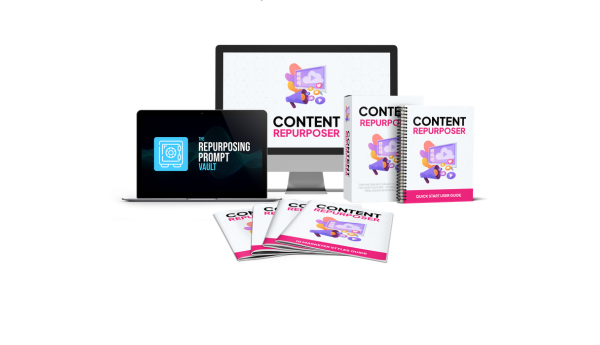
Front-End – Content Repurposer ($9.95 one-time)
- Access to the Content Repurposer GPT for transforming content across platforms
- Includes 10 marketer-style frameworks for different content angles
- Quick start guide for fast setup and ease of use
- Prompt vault with ready-to-use repurposing templates
- Beginner-friendly system for turning one idea into multiple content pieces
- 100% commissions available on front-end sales
OTO 1 – White Label Rights ($27 one-time)
- Full white label license to rebrand and sell as your own product
- Includes GPT template and step-by-step video setup tutorial
- Rebrandable user guide and official license certificate
- Done-for-you sales copy, email swipes, and social posts
- Studio-quality graphics pack for professional marketing
- Ideal for users who want to resell and build a product business
OTO 2 – Content Multiplier Stack ($67 one-time)
- Includes multiple GPT tools for content creation and scaling
- 30-Day Social Crafter for consistent posting
- Viral Video Crafter for high-engagement video ideas
- StorySelling Blogger for long-form content creation
- Comes with rebrandable assets, sales copy, and marketing materials
- Includes email swipes, social posts, and premium graphics packs
- Best for users who want a complete content creation and monetization system
How a Content Repurposer Works: From Single Asset to Content System
A content supply chain is a systematic sequence that all high-output content operations follow. Repurposing is not an afterthought; it is a built-in step of production.
The order of the logic is clear: pillar content → macro assets → micro assets → distribution. Your main event is a 60-minute webinar. Your macro assets are a short overview of your blog and a highlight reel. Your micro assets include brief clips, quote images, and excerpts from your newsletter. Distribution is the process of planning and posting the micro assets on several platforms.
This is how it appears in practice:
Webinar, transcript, topic clusters, social posts, newsletter, and lead magnet PDF
Blogs, videos, podcasts, webinars, research reports, and ebooks are all examples of inputs to this system. Outputs are short films, LinkedIn carousels, Twitter/X threads, email sequences, checklists, infographics, audiograms, and PowerPoint decks. The content repurposer, whether it's a method, a person, or a software platform, conducts its job by changing the input into the output.
It's important to know how tools and people work together in this supply chain. AI-powered software takes care of volume, speed, and making the first draft. Human editors take care of brand voice, nuance, and the order of events. Later parts will explain you exactly how this works in each format.
Step 1 – Audit and Select High-Value Content Assets
Not all stuff is worth saving for later. The first thing to do is figure out what has already earned its spot.
Look for content that is in the top 10–20% of your performance indicators, has high engagement, high conversion rates, is on a topic that will always be relevant, or has original insights that last over time. Use analytics tools like Google Analytics and Search Console, CRM data, and social media insights to find these high achievers.
When auditing, give priority to assets that meet at least two of the following requirements:
- Evergreen topic with sustained search demand
- Demonstrated engagement or conversion history
- Unique framework, data point, or proprietary insight
- Broad enough to be broken into multiple distinct ideas
- Still accurate, or updatable with minimal effort
Step 2 – Extract Core Ideas, Hooks, and Segments
After you choose your pillar asset, the following step is extraction, which means taking away the building pieces that will make new content.
When writing material, use headings, subheadings, and sections that get a lot of traffic as natural breaks. Transcription tools turn spoken words into text that can be searched and edited for audio and video. From the transcript, find the most important statements, data points, frameworks, tales, memorable quotes, and questions that your audience asked in a FAQ manner.
These extracted parts are the raw materials, the building blocks that will be turned into assets that fit the format in the next stage.
Step 3 – Map Ideas to Formats and Channels
Every concept has a place where it belongs, but it might have more than one. The goal is to find the platform formats and audience behaviors where the extracted content units will work best.
Source Idea Type | Best Repurposed As |
Framework or model | Carousel, blog section, webinar slide |
Story or case study | Short video, email sequence, LinkedIn post |
Stat or data insight | Quote graphic, Twitter/X thread, hook line |
FAQ or common objection | Short-form video, community post, chatbot |
Step-by-step process | Checklist, infographic, tutorial video |
The mapping process makes you think strategically. A stat isn't a video script, but it can be a great way to get people interested in one. A case study is not a carousel, but three phrases from it could make the strongest slide.
Step 4 – Produce and Adapt Content (Manual vs. With Tools)
Making the real assets is where most teams either speed up or slow down. Changing something to fit a different screen is not enough for adaptation. Every format needs its own tone, pace, organization, and call to action.
Check this list of quality standards before you publish any reused asset:
- Does it carry a unique angle, even if the idea originated elsewhere?
- Is the formatting native to the platform (e.g., vertical video, single-image carousel)?
- Does the CTA reflect the specific audience on that channel?
- Is the brand voice consistent with the original asset?
- Has any AI-generated draft been reviewed and edited by a human?
Software platforms designed for content repurposing can generate first drafts, suggest format changes, and detect tone discrepancies. The efficiency increase is genuine, but the end product should always represent human judgment.
Step 5 – Schedule, Publish, and Measure
Publishing reused material without a calendar leads to a different issue: channel saturation and audience fatigue. Space assets intentionally, using each format as a chapter in a larger content narrative rather than a flash of repetition.
Key performance parameters to monitor by channel:
- Social media: engagement rate, saves, shares, reach per post
- Email: open rate, click-through rate, reply rate
- Blog/SEO: organic traffic, dwell time, backlink acquisition
- Video: average watch time, subscriber conversion, CTR
Use this information to guide your next repurposing cycle. What worked? What fell flat? The answer explains what to repurpose and what to retire.
Practical Examples: What a Content Repurposer Produces From Different Formats
Blog Post → Multi-Channel Content Repurposing
A well-researched blog post of 1,500 to 2,000 words has significantly more content potential than a single URL. Each part represents a distinct notion. Each data point represents a social asset. Every step in a framework is a video hook.
A content repurposer can produce the following from only one blog post:
- 3–5 LinkedIn posts (one per key insight or section)
- 2–3 Twitter/X threads (structured around the article's core argument)
- 3–5 Instagram or LinkedIn carousels (visual breakdowns of frameworks)
- 1–2 email newsletters (a summarized version with a “read more” link)
- 1 video script or webinar mini-outline (expanding the central thesis)
Tools like Content Repurposer may generate first-draft social posts from a blog URL, reducing production time by a factor of five or more.
Video or Webinar → Clips, Shorts, and Social Proof
Video is the most effective pillar format in a repurposing system. A single 30-60 minute webinar or long-form film contains a library of content ready to be extracted.
A content repurposer can generate the following from only one webinar or video session:
- 10–20 short clips (platform-native for Reels, Shorts, TikTok)
- 5–10 quote graphics (pulled from high-impact statements in the transcript)
- 1–2 blog post summaries (transcript-based, structured for SEO)
- 1 highlight reel (a condensed 3–5 minute best-of compilation)
- 1 FAQ post based on audience questions submitted during the live session
The highlight reel and FAQ post, in particular, do two things: they build social proof and provide evergreen search material.
Podcast or Audio → Written and Visual Content
Audio-first creators often don't see the promise that's in every episode. When a 45-minute podcast show is transcribed, it turns into a content ecosystem.
A content repurposer can make the following things from a single radio episode:
- A transcript-based blog post (with SEO formatting applied)
- 3–5 LinkedIn posts built from the episode's core ideas
- Audiograms — short branded audio clips with waveform visuals
- An email recap with a “listen now” CTA driving traffic back to the episode
It doesn't matter if your audience is mostly radio; your secondary content formats will help people find you on search engines and new platforms.
Long-Form Assets (eBook, Research Report) → Lead Generation Systems
An ebook or study report might be the most content-heavy thing a brand can make. It doesn't get shared as much as it should as a single printable PDF very often.
The following things can be made from one ebook or study report:
- Chapter-based blog posts (each chapter becomes a standalone SEO article)
- A slide deck (condensed for webinar or social presentation use)
- Lead magnet checklists (actionable summaries from each chapter)
- A nurture email series (5–10 emails expanding on key chapter findings)
At this level, it's too hard to manage the process by hand. That's where software solutions that are made to be used for more than one thing earn their spot in the stack.
When to Use a Content Repurposer vs. Creating From Scratch
Does reusing anything replace making it new? No, that's not the answer. Knowing when to execute each is what makes tactical execution different from strategic content planning.
When the source content has already shown its worth, repurposing works. Evergreen themes, instructions that operate well, and complicated frameworks that need to be explained in more than one way are all good candidates. The main idea has been tested in the market. The format and the channel are what change.
When the situation calls for it, new content is needed. You need new messaging for a new product launch. News that is breaking in the sector needs to be reported on quickly. When a big brand changes its position, it needs new stories. Using old content in that period would make things less clear, not more clear.
Situation | Repurpose? | Why / Why Not |
Evergreen “how-to” guide | Yes | Extend lifespan and diversify reach |
Breaking industry news | No | Requires timely, original coverage |
Rebranding announcement | Mostly new | Old messaging undermines new positioning |
High-performing webinar | Yes | Strong signals justify reactivation |
Product feature update | Partial | New details need original coverage |
Ask yourself three questions before deciding:
- Has this topic already demonstrated audience interest or conversion value?
- Can this asset be broken into multiple distinct ideas without losing meaning?
- Will adapting this content to a new format add genuine value for that audience?
If all three answers are yes, repurpose.
AI Content Repurposers vs. Manual Repurposing in 2026
AI has completely transformed what can be done in a content repurposing operation.
An AI content repurposer is a type of software that uses models to take one piece of material (such a blog URL, transcript, or video file) and automatically create new outputs in other formats. The speed advantage is not small. An AI tool can write anything in less than five minutes that would take a human editor two hours.
Dimension | AI Repurposing | Manual Repurposing | Hybrid Model |
Speed | Very High | Low | High |
Output Quality | Moderate (unedited) | High | High |
Brand Fit | Low–Moderate | High | High |
SEO Safety | Moderate | High | High |
Scalability | Very High | Low | High |
Cost per Asset | Low | High | Moderate |
AI Advantages:
- Processes large volumes of content simultaneously.
- Generates first drafts across multiple formats from a single input.
- Scales output without scaling headcount.
AI Limitations:
- Outputs tend toward the generic without prompt engineering.
- Brand voice nuance is often lost or flattened.
- Hallucinations require human review and fact-checking.
The answer in 2026 is neither AI or manual; it's a mix of the two. Use AI to make first drafts and show different ways to structure them. Use human editors to check for accuracy, use the brand voice, and make decisions about the order of things. This is the basic idea behind platforms like Content Repurposer.
FAQs About Content Repurposers
Is using an AI Content Repurposer safe for SEO in 2026?
Yes, but only under certain conditions. Google's search rules look at how helpful, accurate, and original material is, not what tool was used to make it. Content created by AI that is reviewed, edited, and improved by a person before it is published is treated the same as content written by hand. Publishing a lot of unedited AI output is risky since it can make content that is weak, repetitious, or wrong, which makes it look bad to both search engines and readers.
What is the difference between a Content Repurposer and a content scheduler?
A content scheduler decides when and where to post content. A content repurposer decides what that material will be before it is scheduled. The two tools do similar things in a content operation, but they work on separate parts of the process. Many recent platforms combine both features, yet they each fix a different problem.
What types of content work best with a Content Repurposer?
Long-form, high-density content is the finest source for repurposing. This includes webinars, research reports, pillar blog articles, podcast episodes, and interview transcripts. The more useful the original asset is, the more likely it is to be extracted. Short-form material, like a 280-character post or a 30-second film, doesn't often have enough ideas to be split into useful sub-assets.
Can I use a Content Repurposer with only short-form content?
Yes, in theory, but the returns go down a lot. A short-form item doesn't have the conceptual range needed to make different format variations without repeating the same idea. Using short-form content as output from repurposing, not as input to it, is the more productive way to go. Begin with a pillar piece and let short-form assets flow from it.
Is a Content Repurposer the same as content recycling?
Not quite. Recycling content usually means utilizing it again with only a few changes, like reposting a post or sharing a link again. A content repurposer changes content into new formats that are better for different situations and consumers. The difference is between changing and repeating. Recycling saves things, whereas repurposing makes them new.
How often should I repurpose the same content piece?
There isn't a hard and fast rule, but here's a good one: repurpose when the main idea is still important from a business point of view and when a new style or channel would help it reach people who haven't seen it before. For issues that will always be useful, one pillar piece can be used again and again for two to three cycles over the course of 12 to 18 months, especially if it is updated with new information or examples in between cycles.
Do I need a dedicated Content Repurposer role on my team?
It depends on how much information you want to share and how you plan to do it. Repurposing is a function that makes teams more efficient when they regularly post on three or more channels. This function can be a person, a process, or a software platform. Smaller teams can add recycling as a step to their current production process without hiring more people.
What is the risk of duplicate content when repurposing?
The possibility of duplicate content exists, but it can be managed. The key distinction is a significant shift. A blog post recycled into a LinkedIn carousel is not duplicate content; the format, structure, and platform context are all unique. The risk comes when recycled text is published as a standalone web page with minimal difference from the original. To mitigate this, ensure that each recycled online asset has a distinct framing, updated examples, or format-native structure.
Which metrics show that my content repurposer strategy is working?
Keep an eye on performance at two levels. At the asset level, keep an eye on how people interact with each platform, including reach, saves, click-through rate, and watch time. At the strategic level, keep an eye on the return on investment (ROI) for each original asset, the number of assets produced by one pillar, and the overall performance of the cluster. It's a good sign if your organic traffic is going up, your cost per lead is going down, and your topical authority signals in search are getting better.
Should I start with a Content Repurposer tool or build a manual workflow first?
First, make the workflow. No tool can replace the basic knowledge of why you repurpose, which assets to start with, and how to match ideas to formats. Once you know how your workflow works and how your content supply chain works, adding a software platform like Content Repurposer speeds up execution without making you rely on a system you don't fully understand. The approach is what the tool is for, not the other way around.
[/tie_list] [/box]- SPECIAL BONUS 1 – MultiNetwork Poster

- SPECIAL BONUS 2 – ContentLynk

- SPECIAL BONUS 3 – AK Booster Pro

- SPECIAL BONUS 4 – FB MultiPoster

- SPECIAL BONUS 5 – GramHood

- SPECIAL BONUS 6 – Serp Scribe

- SPECIAL BONUS 7 – RankMe

- SPECIAL BONUS 8 – RankMe