 Demon VS Robot DVSR Marketing Website
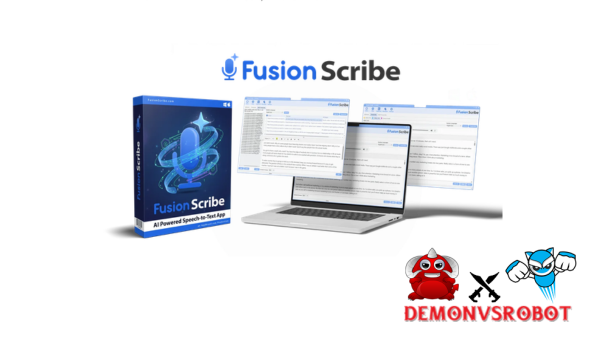
Fusion Scribe is an AI transcription app for Windows and Mac that runs OpenAI Whisper models on your computer. It works in over 100 languages and comes with a one-time license that lets you use it as much as you like. Dave Guindon, who has been working with software, tools, and technology for more than ten years through the Fusion Scribe brand, designed it. The application turns audio and video clips into correct text. Then, it adds AI-powered features, summaries, key insights, and YouTube-style chapters, all without transferring your videos to a cloud server.
This tutorial has all the information you need to use and understand the tool. You will find out what Fusion Scribe is, how it works from installation to export, what each major feature implies in practice, who it is for, and how it compares to other tools like Descript and Otter.ai. There are later sections that talk about advanced AI workflows, their advantages and downsides, and common questions. This way, you can make an informed choice no matter where you are in the research process.
People who have used the program generally say two things: they were amazed with how near the transcribing accuracy was to manual effort, and they were also surprised at how quickly a 60-minute tape became a completely structured, chapter-ready piece of content.
What Is Fusion Scribe? (Plain-English Meaning & Core Value)

Fusion Scribe is a desktop app that uses AI to transcribe and repurpose audio and video into accurate, multilingual text. It then uses AI technologies on the device to make summaries, insights, and chapters, all without sending any files to the cloud.
Fusion Scribe is not a cloud-based software as a service (SaaS) platform. This is not a service for medical scribes. It is a desktop tool that installs on your computer and uses OpenAI Whisper to process your files locally. It then sends you finished transcripts and AI-generated content assets in one workflow.
Its main goals are to accurately turn speech into text in a wide range of languages and audio situations, and to enable you turn that text into useful material like blog posts, show notes, email summaries, or movies with captions. You could say that it's “Whisper made useful for people who aren't tech-savvy.”
Five value pillars guide most of the design choices for the tool:
- Local processing and privacy: Your audio, video, and transcripts never leave your computer.
- Unlimited transcription: No per-minute fees, no monthly caps, no throttling.
- 100+ language support: Auto-detect and transcribe in over a hundred languages, with an option to translate output into English.
- Bulk processing: Queue and process multiple files in one batch run.
- Built-in AI analysis: Generate summaries, key insights, and timestamps without switching tools.
How Fusion Scribe Works (From Install to Export)
Knowing how the workflow works takes away most of the guesswork that comes with using a new tool. Fusion Scribe has a simple, step-by-step method, and each step is easy to understand, even for people who don't know much about technology.
The workflow from start to finish:
- You may get Fusion Scribe for Windows or Mac from the official site and install it.
- When you initially start Whisper, set up your local model. The program asks you to download one or more model sizes. Larger models need more room on your hard drive, but they are more accurate. Smaller models take up less space and run faster.
- You can add files by dragging and dropping audio or video into the app interface or by searching around your file system.
- Select a language mode: let the app automatically find the language being spoken, choose a language yourself, or turn on English translation for recordings in other languages.
- Choose a transcription model based on what you need most: a faster one for rough drafts or a bigger one for final-quality work.
- Run the transcription on your own computer. Your computer does the work for the app. At this point, you don't need an internet connection to see how things are going on the UI.
- Before exporting, you can read and edit the transcript in the app.
TXT, SRT, VTT, CSV, or JSON are all file types that you can use to export your file. - You can use AI analysis techniques to make a summary, extract out important information, or make chapter markers like those on YouTube from the transcript.
| Model Tier | Speed | Accuracy Level | Best For |
| Tiny | Very fast | Basic | Quick reference drafts, short clips |
| Base | Fast | Good | General content, casual recordings |
| Small | Moderate | Better | Podcast episodes, structured interviews |
| Medium | Slower | High | Multilingual audio, technical terminology |
| Large | Slowest | Highest | Final-grade transcripts, precision work |
It all relies on how much time you can spend processing and how accurate you need the model to be. The Small or Medium tier is a good compromise for most day-to-day content development. The Large model is worth the extra processing time if you need agency-grade output or interviews in more than one language.
Core Features of Fusion Scribe (What You Actually Get)
There are two main goals for Fusion Scribe: to make accurate transcriptions at scale and to allow users to reuse content without having to buy extra tools. This part explains each group of features in detail so that you may comprehend what they signify in real life.
Multi-Language & Translation Support (100+ Languages)
Fusion Scribe can transcribe in more than 100 languages. It can automatically determine the language being said, so you don't have to tell it what language it is. This takes away a manual step from every file for teams who operate with foreign material, multilingual YouTube channels, bilingual podcast series, or cross-border research interviews.
The option for an English translation works just as well. An interview in French can be automatically recognized and translated into English in the same transcription run. This makes it available for evaluation by a worldwide team or release to an international audience. Whisper's core architecture is better at handling accented speech and background noise than other generic speech recognition engines.
Export Formats: TXT, SRT, VTT, CSV, JSON (No Limits)
Fusion Scribe exports transcripts in five formats, each of which is appropriate for a particular downstream workflow. There are no artificial limits on how many exports you can generate.
| Format | Best For | Typical User |
| TXT | Raw text, blog drafts, document archives | Content creators, writers |
| SRT | Video subtitles for YouTube, Vimeo | YouTubers, video editors |
| VTT | Web-native captions, online course platforms | Developers, course creators |
| CSV | Structured content analysis, calendars | Marketers, researchers |
| JSON | Developer pipelines, custom integrations | Engineers, technical agencies |
What you do next depends on the style you pick. SRT goes straight into a video editor or the caption post on YouTube. You can drop a CSV file into a worksheet to look at its contents. JSON makes it possible to connect to other tools.
Built-In AI Analysis: Summaries, Insights, Chapters
Fusion Scribe has more than just the transcript. It also has a set of AI research tools that run locally:
- One-click summaries, available in short or long form, depending on how much detail you need.
- Key insights, extracted highlights from the transcript, useful for show notes or briefing documents.
- Timestamps and YouTube chapters, structured chapter markers generated directly from the content.
A real-world example of a workflow: a 60-minute webinar recording goes through Fusion Scribe and comes out as a full transcript, a summary email, a blog post idea, and a list of YouTube chapter titles, all without having to leave the app.
Local Processing & Privacy: No Cloud Uploads
When you process files locally, your audio, video, and transcript files stay on your computer. Your hardware runs the Whisper models. During transcription or AI analysis, nothing is sent to an outside server.
This difference is important in some situations. Agencies that have signed NDAs with their clients can't upload raw call records to cloud platforms. Researchers who interview people with sensitive information also have to follow the same rules. Journalists who protect their sources feel the same way. Local processing is built to get rid of that risk.
Unlimited Use & One-Time Pricing Model
You can only buy Fusion Scribe once. You only have to pay once, and you can transcribe as much as you like, with no limits on minutes or monthly billing cycles.
For example, a content firm that processes 50 hours of audio per month on a per-minute SaaS platform has costs that keep adding up over time. A one-time license changes that variable cost into a fixed, known cost. The workflow doesn't have any throttling measures, thus you can execute big batch processes without going over your limit.
Bulk Processing & Batch Workflows
In bulk mode, you can queue up several files and run them all at once without having to do anything. You upload the files, set the settings once, and then let the app go through the queue.
The use cases are clear and useful. A podcast producer doesn't have to handle each file separately when they process a whole season's worth of episodes. A company that gets a client's three-month Zoom archive can put up a batch task and send back finished transcripts. A researcher with recordings of interviews in more than one language from a multi-day field study can run them all at once overnight.
Pricing Plans
FE – Fusion Scribe AI – $11
- Unlimited on-device transcription with no monthly fees or credits
- No limits on file size, length, or number of transcriptions
- Supports 100 languages with auto-detect and instant translation
- Convert 50+ audio/video formats into clean, editable text
- Bulk transcribe files or links and manage projects easily
- Built-in recorder, editor, and export formats (TXT, SRT, CSV, JSON)
- AI tools for summarizing, tagging, chapters, and content writing
- Commercial + outsource license with lifetime access and free updates
Real-World Use Cases: Who Fusion Scribe Is For
Features are only part of the story. The value becomes clear when you see how those features fit into real-life work. Fusion Scribe has several user groups, and each group uses the tool in a different way that shows off a new set of the same key features.
Content Creators & YouTubers
A YouTuber who posts one 30-minute video a week runs into a common problem: the transcript, the description, the subtitles, the blog post adaption, and the short-form repurposing all take time.
Fusion Scribe speeds up that process. The author puts in the tape and gets back a full transcript, SRT captions for accessibility and YouTube SEO, and a structured summary that can be used as an outline for a blog post or a portion of a newsletter. If a creator follows this method all the time, they may feasibly turn each video into three to five more pieces of content without having to write anything new. The SRT or VTT caption export also helps people find your content. YouTube keeps track of captions, and proper captions make the tool show up for search terms that are stated in the video but not in the title or description.
Podcasters & Webinar Hosts
Making podcast show notes, episode timestamps, and pull quotes by hand takes a lot of work. Webinar replays without chapter markers lose a lot of their usefulness as on-demand content. Fusion Scribe takes care of both.
The transcript is used to make show notes, timestamp lists, and highlighted quotes for social media sharing in podcast workflows. For people who conduct webinars, the combination of a transcript and AI-generated chapters turns a long recording into a chaptered replay that can be easily navigated. It also comes with a summary sheet that can be used for follow-up emails or handouts for attendees. The “10-hour webinar archive into chapters in an afternoon” result is the direct result of using AI to make chapters and bulk processing.
Marketers & Agencies
Agencies deal with a certain mix of volume and sensitivity. Client discovery calls, user research sessions, and strategy interviews generate audio that contains confidential information, and a large quantity of it. Many customer agreements say that putting that information on a public cloud service is a compliance risk.
Fusion Scribe takes care of the volume by processing a lot of data at once and the compliance issue by processing data in the same place. An agency can batch-transcribe 30 client calls, export them to CSV, and then use the structured data to find messaging patterns, pull out objections, or find content gaps, all without breaking the conditions of the NDA. The one-time license strategy also does rid of the extra costs of charging by the seat or by the minute that add up when teams work on more than one client account at the same time.
Researchers, Journalists, and Educators
Academic researchers who do multilingual interviews have a transcribing problem that most technologies don't do well. A researcher conducting participant interviews in three languages requires precise transcription, English translation, and a format compatible with research documentation software. Fusion Scribe's auto-detect and translation process takes care of this in one go.
Journalists can't upload interview recordings to cloud-based transcription tools because they need to keep their sources' identities secret. Teachers who record lectures need to give students summaries and study-note outlines that they can use with the recording. All three groups need the same basic thing: accurate, private, offline-capable transcription that gives them structured, useable output.
Fusion Scribe vs. Other Transcription Tools (Descript, Otter, Raw Whisper)
In 2026, picking a transcription tool means making real choices about privacy, price, features for working together, and technical needs.
| Tool | Local Processing | Languages | Pricing Model | Bulk Export | AI Insights | Ease of Use |
| Fusion Scribe | ✅ Yes | 100+ | One-time | ✅ Yes | ✅ Yes | Beginner |
| Descript | ❌ Cloud | Limited | Monthly sub | Partial | ✅ Yes | Moderate |
| Otter.ai | ❌ Cloud | English-first | Freemium | Limited | Partial | Very easy |
| Raw Whisper | ✅ Yes | 100+ | Free | Manual | ❌ No | Technical |
In this field, Fusion Scribe has a unique place. This alternative has everything you need in one package: local processing, support for several languages, built-in AI technologies, and an interface that is easy for non-technical users to use. This comparison doesn't show any other tool that can do all four at once.
The use case will determine where rivals have an edge. Descript is the better solution for teams that need to edit videos together in the cloud. Otter.ai is a good choice for transcribing live meetings on mobile. Running Raw Whisper from the command line gives developers the most control, but it doesn't have a user interface or an AI insight layer.
Advanced AI Features, Prompts, and Content Repurposing Workflows
The transcript is where you start, not where you end. You may turn raw transcripts into structured content assets with Fusion Scribe's built-in AI analysis layer. The best approach to use it is with regular workflow patterns instead of one-time exports.
Long-form content and a way to get it out there. A 45-minute interview is transcribed, then summarized by AI, then turned into a blog outline based on the most important points, and finally a series of short social quotes. The transcript is used as source material at each stage, and the output is made for a separate platform.
Interview and FAQ content pipeline. After being transcribed, a discovery call or research interview might be turned into a Q&A format using the information that was gathered. The discussion structure naturally brings up the questions, and the transcript text gives the answers.
Webinar, a pipeline for chaptered replays. With only one Fusion Scribe session, you can get a full transcript, AI-generated chapter markers with timestamps, a short summary for follow-up emails, and a show notes document with timestamps.
Here are some example prompt patterns for AI analysis, organized by role:
- Content creator: “Summarize this transcript in 5 bullets for a newsletter introduction.”
- Marketer: “Extract 10 short, quote-ready statements from this transcript for social media.”
- Researcher: “Identify the 5 main themes discussed and list supporting evidence from the transcript.”
- Educator: “Generate a structured study guide outline based on this lecture transcript.”
- Agency: “Extract all client pain points and objections mentioned in this call.”
Pros and Cons of Fusion Scribe in 2026
Every tool works well in some situations and not so well in others. You can make an honest decision on whether Fusion Scribe matches your workflow if you know both sides.
| Aspect | Pros | Potential Trade-off |
| Privacy | Files never leave your machine | Requires local storage management |
| Pricing | One-time license; no fees | Higher upfront cost than free tiers |
| Language Support | 100+ languages with auto-detect | Accuracy varies by model size |
| AI Tools | Summaries, chapters, insights | Quality scales with model selection |
| Bulk Processing | Process entire archives in one batch | Slower on lower-spec hardware |
| Portability | Stable desktop performance | No native mobile application |
| Setup | Clean UI; no coding required | Initial downloads need disk space |
The local processing model is the tool's biggest strength and the most important thing it needs to work. If you run Whisper models on your own computer, the speed of your computer's processing is what matters. A computer with a good processor and enough RAM can run the Large model without any problems. An older computer may find the Large model slow and do better with the Medium or Small tier.
Users who wish to record meetings or transcribe them on the go will find it hard to do so without a mobile app. Fusion Scribe is made for desktop processes that use files, and it does a great job in that area.
Frequently Asked Questions About Fusion Scribe
What Makes Fusion Scribe Different From Other AI Transcription Tools?
No other direct rival offers all of these features in one package: local processing, built-in AI insight tools, support for more than 100 languages, and a one-time licensing. Most transcribing programs that work in the cloud only have one or two of these features. Fusion Scribe has all four of them.
OpenAI Whisper is the engine behind this. It is one of the most accurate open-source speech recognition models out there. Fusion Scribe adds mass processing and AI analysis to that engine and takes away the per-minute cost paradigm that makes cloud products expensive when used by a lot of people.
Is Fusion Scribe Safe for Confidential or NDA-Bound Recordings?
Yes, local processing means that your recordings stay on your computer throughout the whole procedure. During transcription or AI analysis, no audio, video, or transcript data is sent to servers outside of the company.
You can keep your files and transcripts on an encrypted disk volume for extra security. This adds a layer of protection for critical information at the hardware level. This approach works for legal, medical, journalistic, and agency use cases where privacy is a must, not just a nice-to-have.
Which File Formats Does Fusion Scribe Support?
Fusion Scribe can read a lot of different types of audio and video files. Types that are commonly accepted are
- Audio: MP3, WAV, M4A, AAC, FLAC, OGG
- Video: MP4, MOV, MKV, AVI, WEBM
The app automatically takes out the audio track from video files, so you don't have to convert the video first before loading it. You can get files back in TXT, SRT, VTT, CSV, and JSON forms.
How Accurate Is Fusion Scribe on Noisy Audio or Strong Accents?
The way Whisper is built makes it better at dealing with accents and moderate background noise than other speech recognition systems. Any model won't always work well with difficult sounds, but Whisper does well in situations where many other models fail.
If you want better results with difficult recordings, choose a bigger model (Medium or Large), make sure the recording has a good signal-to-noise ratio, and use the right language setting instead of auto-detect for speech with strong accents. For most properly recorded podcasts and interviews, the basic level of accuracy is high enough that they can be used right away with little editing.
Does Fusion Scribe Need an Internet Connection?
For the first installation and to receive the Whisper model files during setup, you need to be connected to the internet. As soon as you save those models to your computer, you can do nothing else for recording and AI analysis.
This means that Fusion Scribe can be used in places that don't have reliable internet connection, like when doing research in the field, while traveling, or in an office where the network is limited, as long as the initial setup was done while connected.
Can I Use Fusion Scribe on Multiple Computers?
Fusion Scribe works by using a license-based activation scheme. The official Fusion Scribe licensing documentation is the best place to find out how many machines a single license covers or how license transfers work. This is because these terms can vary with each product update. A one-time payment usually comes with a per-device or limited-device license.
How Often Is Fusion Scribe Updated?
Fusion Scribe gets regular upgrades, which makes sense because the firm has a strong history of making software products that last. Updates usually fix bugs, make the program work better with newer versions of the operating system, and provide new features depending on what users say they want.
The tool leverages local Whisper models, thus model updates sent through the app can include enhancements to Whisper itself. This means that improvements in accuracy can be made without having to go through the whole application update cycle.
Does Fusion Scribe Support Real-Time Transcription?
The main purpose of Fusion Scribe is to work with files. You can add an audio or video file, and the app will transcribe it from that source. Real-time tools that handle a microphone feed or a live meeting stream are not the same as this.
A live-transcription tool like Otter.ai would be better for your needs if you want to record live talks as they happen, whether they are on a video call or in person. For all processes that happen after recording, Fusion Scribe's file-based model is more accurate and better organized for making content.
Can Developers Integrate Fusion Scribe Into Other Tools?
CSV and JSON output formats are the most useful integration points for developers. A JSON export from Fusion Scribe can be read by downstream tools, content management systems, or custom data pipelines that use simple parsing algorithms.
Direct API integration, or using Fusion Scribe programmatically from another application, is dependent on whether the application provides a developer API. The export-based approach is recommended for teams that require more in-depth integration. Developers who require complete programmatic control over the Whisper engine itself may prefer to run raw Whisper via the CLI.
Is Fusion Scribe Suitable for Teams and Agencies?
Fusion Scribe is a good choice for agency workflows, especially when privacy, volume, and cost predictability are important. The bulk processing feature can handle large audio archives without adding costs per minute. The local processing solution meets NDA and privacy restrictions that keep most cloud technologies from working with sensitive client data.
In team settings, the most usual solution is to have separate licenses for each computer and to share transcript results in TXT, CSV, or JSON format through standard file-sharing or project management systems. It's not a collaborative editing tool; it's a transcription and content-extraction engine.
[/tie_list] [/box]- SPECIAL BONUS 1 – MultiNetwork Poster

- SPECIAL BONUS 2 – ContentLynk

- SPECIAL BONUS 3 – AK Booster Pro

- SPECIAL BONUS 4 – FB MultiPoster

- SPECIAL BONUS 5 – GramHood

- SPECIAL BONUS 6 – Serp Scribe

- SPECIAL BONUS 7 – RankMe

- SPECIAL BONUS 8 – RankMe